Presentation of the Best Practice
Target challenge
- Environmental pollution
- Move towards zero discharge at local level
- Vulnerability to climate Change
Area Typology
- Urban area
- Other (Please specify below)
- Dense Urban
Main beneficiaries
- Local Population
- Municipalities
- Other (Please specify below)
- University community, including staff, students, attendees, etc
Impact on the beneficiaries of your Best Practice:
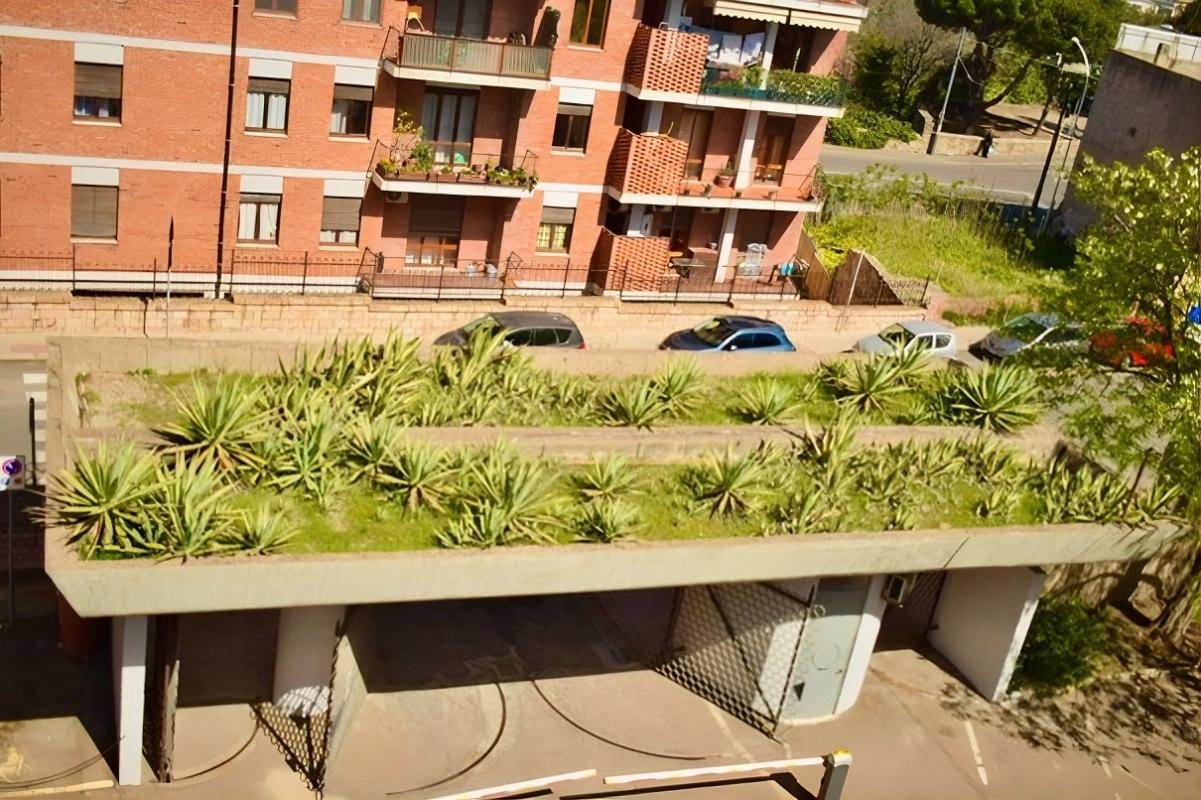
The intensive CAM green roof at the University of Cagliari delivers multiple benefits to its beneficiaries by integrating stormwater management, ecological, and energy-related functions.
• Urban flood risk reduction: The system significantly mitigates peak runoff during extreme rainfall events, with an Index of Retention for extreme events (IOR95) of 0.38, contributing to resilient urban drainage systems.
• Enhanced urban resilience: By retaining and slowly releasing rainwater, the roof reduces pressure on the drainage network, supporting cities in adapting to climate variability and extreme weather.
• Improved quality of life: The vegetated roof enhances urban aesthetics, supports biodiversity, and contributes to air quality improvement, creating a more pleasant and healthier environment for building users and the surrounding community.
• Energy savings: Through latent heat flux and evaporative cooling, the roof helps regulate indoor temperatures, potentially reducing energy demand for air conditioning.
Overall, the system provides hydrological, ecological, and energy-related co-benefits, demonstrating how a low-maintenance green roof can simultaneously improve urban sustainability, resilience, and quality of life.
• Urban flood risk reduction: The system significantly mitigates peak runoff during extreme rainfall events, with an Index of Retention for extreme events (IOR95) of 0.38, contributing to resilient urban drainage systems.
• Enhanced urban resilience: By retaining and slowly releasing rainwater, the roof reduces pressure on the drainage network, supporting cities in adapting to climate variability and extreme weather.
• Improved quality of life: The vegetated roof enhances urban aesthetics, supports biodiversity, and contributes to air quality improvement, creating a more pleasant and healthier environment for building users and the surrounding community.
• Energy savings: Through latent heat flux and evaporative cooling, the roof helps regulate indoor temperatures, potentially reducing energy demand for air conditioning.
Overall, the system provides hydrological, ecological, and energy-related co-benefits, demonstrating how a low-maintenance green roof can simultaneously improve urban sustainability, resilience, and quality of life.
Funding
- National funding
Used technologies / tools
- Nature based process
- Soil infiltration
- Sustainable Drainage Systems
- Evaporation
- Others
- Kalyx-RG rain gauge (UM-780-700 by Environmental Measurements Limited - EML);
- EHSM: Ecohydrological Streamflow Model;
- CAM: Crassulacean Acid Metabolism.
Implementation site
Cagliari
NCW type
- Rainwater (RW)
NCW USE
- Garden Irrigation
Self-Assessment
TRL : Technology Levels
TRL9
Description of the innovative component:
Yes, the Best Practice includes an innovative component. The innovation of the intensive CAM green roof at the University of Cagliari lies in its scientific validation and monitoring of hydrological performance in a Mediterranean context.
Specifically, this green roof represents the first rigorous assessment of the flood-mitigation capacity of spontaneous CAM vegetation (Agave americana), addressing a research gap on how CAM compare with conventional C3 vegetation in terms of rainwater retention and runoff reduction.
In addition, the system is equipped with continuous high-resolution monitoring, recording rainfall at 0.2 mm resolution and outflow every 5 minutes, providing detailed quantitative data on hydrological performance. This monitoring was implemented on a zero-maintenance, self-sustaining system, demonstrating that CAM vegetation can deliver long-term retention benefits without irrigation or ongoing maintenance. Finally, the roof serves as a benchmark for future blue-green infrastructure, such as the CAM Polder Roof prototype with integrated water tanks, linking ecological sustainability with stormwater.
Specifically, this green roof represents the first rigorous assessment of the flood-mitigation capacity of spontaneous CAM vegetation (Agave americana), addressing a research gap on how CAM compare with conventional C3 vegetation in terms of rainwater retention and runoff reduction.
In addition, the system is equipped with continuous high-resolution monitoring, recording rainfall at 0.2 mm resolution and outflow every 5 minutes, providing detailed quantitative data on hydrological performance. This monitoring was implemented on a zero-maintenance, self-sustaining system, demonstrating that CAM vegetation can deliver long-term retention benefits without irrigation or ongoing maintenance. Finally, the roof serves as a benchmark for future blue-green infrastructure, such as the CAM Polder Roof prototype with integrated water tanks, linking ecological sustainability with stormwater.
Obstacles to implementation
- Other (Please specify below)
- Cagliari's green roof faced no major obstacles. Built in 1980 with CAM vegetation, its stable structure allowed a smooth 2016 retrofit with monitoring sensors, presenting no construction, maintenance, or operational barriers .
Obstacles to funding
Highly competitive funding calls.
How your Best Practice is economically feasible ?
The intensive CAM green roof at the University of Cagliari is economically feasible due to its minimal operational costs and low retrofit investment.Key factors include:
Zero maintenance costs: The spontaneous CAM vegetation (Agave americana) is drought-resistant and self-sustaining, requiring no irrigation or routine care. In contrast, an equivalent green roof planted with conventional C3 species would need approximately 72 m³ of water per year, corresponding to a savings of around €108/year at a water cost of €1.5/m³.
Low retrofit costs: The only significant investment for system enhancement was the installation of hydrological monitoring sensors in 2016, without major structural modifications.
The monitoring system relies on scientific projects.
Result of this assessment
No sustainability assessment was undertaken.Enviromental impact
SDGs
Energy consumption comment
No energy consumed
Validation/upscaling
For the intensive CAM green roof at the University of Cagliari, the Best Practice has been validated but not physically upscaled.
The roof’s hydrological performance has been confirmed through…
The roof’s hydrological performance has been confirmed through…
Potentiel of exploitation/outscaling
Yes, the intensive CAM green roof at the University of Cagliari has strong potential for replication and upscaling. Its modular and simple design, based on a 30 cm sandy soil layer and low-…
Lessons learnt
The intensive CAM green roof at the University of Cagliari has provided several valuable lessons from its design, implementation, and long-term monitoring. The spontaneous CAM vegetation (Agave…
Recommandations
To promote the wider adoption of green roofs, policy measures should combine financial incentives, public engagement, and regulatory integration. Providing subsidies, grants, or tax incentives,…
Highlighted KPI
Technical indicators
Average Treated flow rate
m3/Day
Economical indicators
Average total Cost
euro/m3 terated/day
Without consideration of the depreciation period
Land footprint
480.00
m2/m3/day


Social impact of the BP
Jobs created
Jobs created comment: 3-4 researcher positions during several projects