Presentation of the Best Practice
Target challenge
- Water for irrigation and food production is not available
- Move towards zero discharge at local level
- High treatment cost
- Vulnerability to climate Change
- Other (Please specify below)
- Insufficient water for urban irrigation
Area Typology
- Urban area
- Other (Please specify below)
- Peri-Urban, Green Areas or Parks
Main beneficiaries
- Local Population
- Municipalities
Impact on the beneficiaries of your Best Practice:
By reusing rainwater and pool overflow water, municipal water consumption is reduced, and water resources are used more efficiently.
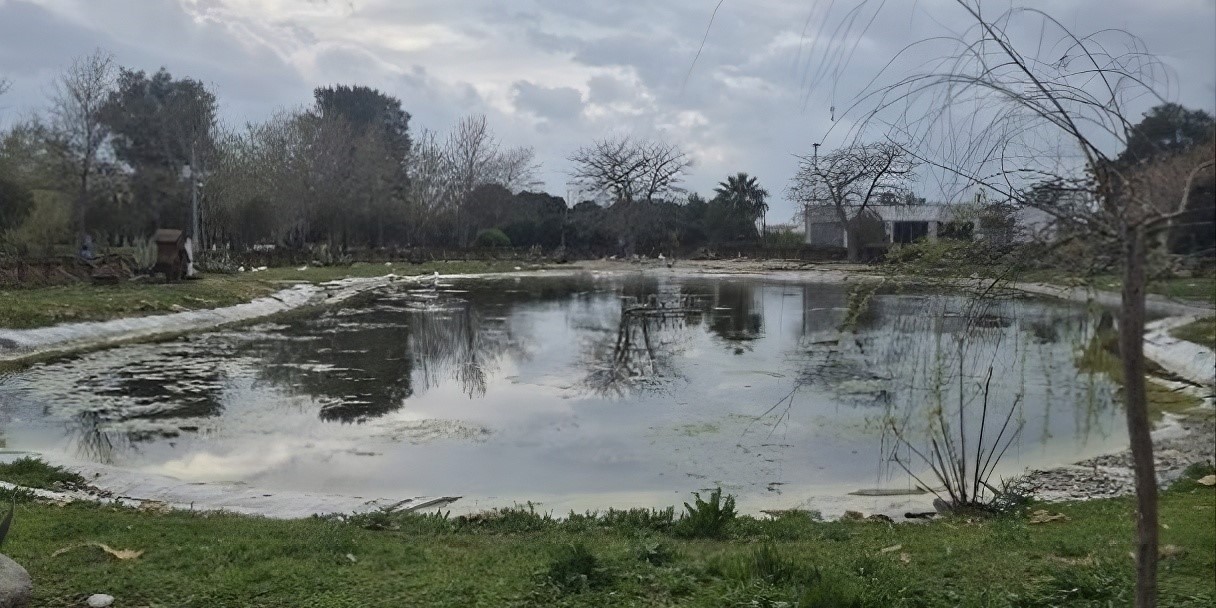
The continuous replenishment of the artificial pond enhances the aesthetic and recreational value of the landscaped areas, creating higher-quality open spaces for users.
The use of collected water for irrigating green areas supports the continuity of vegetation, ensuring a healthier and more vibrant landscape environment.
Making environmentally friendly practices more visible to users contributes to raising awareness about water conservation and the protection of natural resources.
The continuous replenishment of the artificial pond enhances the aesthetic and recreational value of the landscaped areas, creating higher-quality open spaces for users.
The use of collected water for irrigating green areas supports the continuity of vegetation, ensuring a healthier and more vibrant landscape environment.
Making environmentally friendly practices more visible to users contributes to raising awareness about water conservation and the protection of natural resources.
Used technologies / tools
- Chlorination
- Constructed Wetland
- Sustainable Drainage Systems
- Physical process
- Filtration
- Existing swimming pool pumps have been used
- Gravity-fed water distribution network
- Rainwater harvesting system
- Artificial pond feeding system
- Automated irrigation diversion system
- Controlled flood structure
- Drainage channel system
Implementation site
İzmir
NCW type
- Rainwater (RW)
- Greywater (GW)
- Other
NCW USE
- Ecosystem
- Landscaping
- Garden Irrigation
- Recreation Area
- Other (Please specify below)
Self-Assessment
TRL : Technology Levels
TRL8
Description of the innovative component:
• Utilizing the land conditions to reuse swimming pool wastewater with a simple method
• Multiple Water Source Integration: Collecting and utilizing rainwater harvested from roof surfaces and overflow water from swimming pools, within the same system is an innovative approach that enables the integrated use of alternative water sources.
• Smart Water Distribution and Prioritization Mechanism: This is an innovative management model that ensures the collected water is primarily used to feed the artificial pond, and if capacity is exceeded, it is redirected to the irrigation system, thus providing a gradual and efficient use of water according to need.
• Multiple Water Source Integration: Collecting and utilizing rainwater harvested from roof surfaces and overflow water from swimming pools, within the same system is an innovative approach that enables the integrated use of alternative water sources.
• Smart Water Distribution and Prioritization Mechanism: This is an innovative management model that ensures the collected water is primarily used to feed the artificial pond, and if capacity is exceeded, it is redirected to the irrigation system, thus providing a gradual and efficient use of water according to need.
Obstacles to implementation
- High cost of technological solutions
Obstacles to funding
None, because it was done using simple equipment.
How your Best Practice is economically feasible ?
Through the public authority’s own resources.Result of this assessment
The reuse of swimming pool wastewater provides a positive sustainability approach by saving water and supporting circular water management at the local level.Enviromental impact
SDGs
Energy consumption KWh/m3
1.50
Validation/upscaling
The effectiveness of the implementation and its fulfilment of the targeted performance criteria are verified through regular monitoring and performance evaluation studies. In this context, rainwater…
Potentiel of exploitation/outscaling
The developed integrated rainwater harvesting, pool water recovery, and artificial pond-supported water management system has high potential for replicability and scalability thanks to its modular…
Lessons learnt
It has been shown that integrating different alternative water sources (such as rainwater and pool overflow water) into a single system significantly increases water efficiency. Reusing resources…
Recommandations
Continuous monitoring of water levels, storage volumes, irrigation consumption, and flood discharge amounts via sensors allows for real-time performance evaluation and rapid identification of…
Highlighted KPI
Technical indicators
Average Treated flow rate
m3/Day
Salinity15000 g/Day
Suspended solids SS125 g/Day
COD175 g/Day
Economical indicators
Average total Cost
euro/m3 terated/day
Without consideration of the depreciation period
Average O&M cost
euro/m3 terated/day
Land footprint
60.00
m2/m3/day


Social impact of the BP
Jobs created comment: None