
Presentation of the Best Practice
Target challenge
- Environmental pollution
- Degradation of the Ecosystem (water stress)
- Vulnerability to climate Change
- Other (Please specify below)
- Extreme rain risks urban flooding and drainage overload. This practice attenuates runoff through temporary storage and controlled discharge, feeding the Murcia Este system to indirectly boost water for agricultural irrigation .
Area Typology
- Urban area
- Other (Please specify below)
- Dense Urban
Main beneficiaries
- Water Utilities
- Local Population
- Municipalities
- Management Authorities
- Other (Please specify below)
- Extreme rain risks urban flooding and drainage overload. This practice attenuates runoff through temporary storage and controlled discharge, feeding the Murcia Este system to indirectly boost water for agricultural irrigation.
Impact on the beneficiaries of your Best Practice:
The Best Practice benefits users of the 404-space Park & Ride facility through increased accessibility and reduced flood risk during rainfall events. The Municipality of Murcia benefits from improved urban resilience and reduced pressure on the drainage network. Additional benefits extend to downstream irrigation users because the collected stormwater ultimately reaches the Murcia Este reclamation system, contributing to reclaimed-water resources used in agriculture in a region affected by structural water scarcity.
Funding
- National funding
Used technologies / tools
- Nature based process
- Soil infiltration
- Sustainable Drainage Systems
- Others
- SUDS (Sustainable Urban Drainage System)
- PLC (Programmable Logic Controller)
- PP (Permeable Pavement)
Implementation site
Murcia
NCW type
- Rainwater (RW)
NCW USE
- Landscaping
- Recreation Area
- Other (Please specify below)
Self-Assessment
TRL : Technology Levels
TRL8
Description of the innovative component:
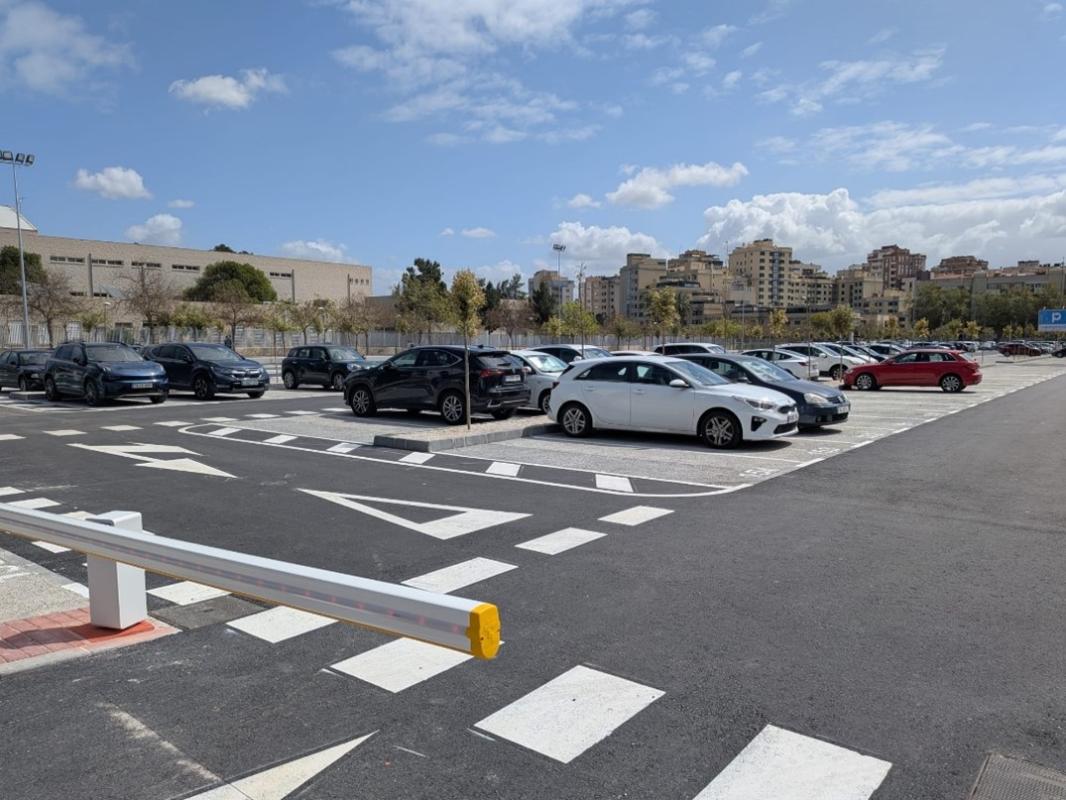
The innovative aspect is the integration of sustainable stormwater management and urban mobility within Murcia’s largest Park & Ride facility. Unlike conventional parking developments, the project combines a permeable pavement system, 5,451 m² of subsurface gravel storage and infiltration infrastructure, regulated discharge through a vortex-controlled outlet, urban greening and smart monitoring within a single operational facility with 404 parking spaces. The system provides up to 1.4 million litres of temporary storage and regulates discharge from 230 to 4 l/s, enabling recovery within approximately 48 hours. The collected stormwater is ultimately conveyed to the Murcia Este reclamation system, contributing indirectly to water reuse for agricultural irrigation in a region affected by structural water scarcity. The innovation therefore lies in simultaneously addressing sustainable mobility, flood-risk reduction and water-resource management.
Its novelty lies not in the individual SUDS components, which are already known technologies, but in their integration within Murcia’s largest municipal Park & Ride facility, combining sustainable mobility, flood-risk reduction and indirect support to reclaimed-water production within a single urban infrastructure.
Its novelty lies not in the individual SUDS components, which are already known technologies, but in their integration within Murcia’s largest municipal Park & Ride facility, combining sustainable mobility, flood-risk reduction and indirect support to reclaimed-water production within a single urban infrastructure.
Obstacles to implementation
- High cost of technological solutions
- Other (Please specify below)
- Coordination with multiple underground utility networks during design and construction.; • Additional implementation costs compared with conventional stormwater drainage solutions
Obstacles to funding
No significant difficulties in accessing funding were reported. The main challenge was demonstrating the long-term environmental and resilience benefits of the SUDS approach compared with conventional drainage solutions during project planning and approval
How your Best Practice is economically feasible ?
The project was implemented as public urban infrastructure financed by Murcia City Council. Financial feasibility is supported by the integration of stormwater management, climate adaptation and sustainable mobility objectives within a single municipal investment. Although no formal cost-benefit analysis was identified in the reviewed documentation, the project justification is based on flood-risk reduction, improved urban resilience, groundwater recharge and environmental co-benefits associated with green infrastructure.Result of this assessment
No formal sustainability assessment report was identified in the available documentation. However, project documentation indicates expected benefits including stormwater infiltration, flood mitigation, groundwater recharge, reduced runoff, urban greening, support for climate adaptation and mitigation of urban heat-island effects through the integration of 152 trees and 936 shrubs. These should be considered expected project outcomes rather than results of a formal sustainability assessment.Enviromental impact
SDGs
Energy consumption comment
site-specific monitoring data not available
Validation/upscaling
The facility was inaugurated on 24 March 2026 and opened to the public on 25 March 2026. Following commissioning, rainfall events recorded at the end of March 2026 generated approximately 20 l/m² of…
Potentiel of exploitation/outscaling
Replication is suitable for public parking facilities, transport interchanges and other large impervious urban areas. Key conditions include sufficient available space, favourable soil infiltration…
Lessons learnt
The project demonstrates that sustainable drainage infrastructure can be successfully integrated within urban mobility facilities. Early coordination with utility operators is essential because…
Recommandations
Replication should be considered in urban mobility facilities, public parking areas and other large impervious surfaces where runoff generation is significant. Successful implementation requires…
Highlighted KPI
Technical indicators
Average Treated flow rate
m3/Day
Economical indicators
Average total Cost
euro/m3 terated/day
Without consideration of the depreciation period
Land footprint
1064.00
m2/m3/day


Social impact of the BP
Jobs created
Jobs created comment: Approximately 20–25 temporary construction jobs and 2–3 indirect annual maintenance jobs