Presentation of the Best Practice
Target challenge
- Difficult access to water
- Environmental pollution
- Move towards zero discharge at local level
- Low sustainability of the treatment system
- Vulnerability to climate Change
- Other (Please specify below)
- Significant water losses that occur at the water treatment plant. / Urban water supply network is struggling to meet demand.
Area Typology
- Urban area
Main beneficiaries
- Water Utilities
- Local Population
- Municipalities
- Householders
- Other (Please specify below)
- Industries
Impact on the beneficiaries of your Best Practice:
Within the framework of the Programme, GWP-Med places particular emphasis on social impact. In addition to increasing water availability for the local community and enabling the water treatment plant (WTP) to achieve zero-discharge operation, GWP-Med collaborated with the Mediterranean Education Initiative on Environment and Sustainability (MEdIES) to implement educational activities for school students and teachers. A total of 235 students participated in hands-on, interactive learning activities, including the Water Magnetic Board and the Snakes and Ladders educational game, designed to raise awareness of water resources and sustainable water management. Teachers, in collaboration with the Centre for Environmental Education (CEE) of Thiva, Boeotia, also took part in capacity-building events focused on strengthening water resources education and environmental awareness.
Funding
- Private financing
Used technologies / tools
- Desinfection process
- Chlorination
- Physical process
- Sedimentation
- Screening
- Flocculation-coagulation
- Filtration
- Dewatering
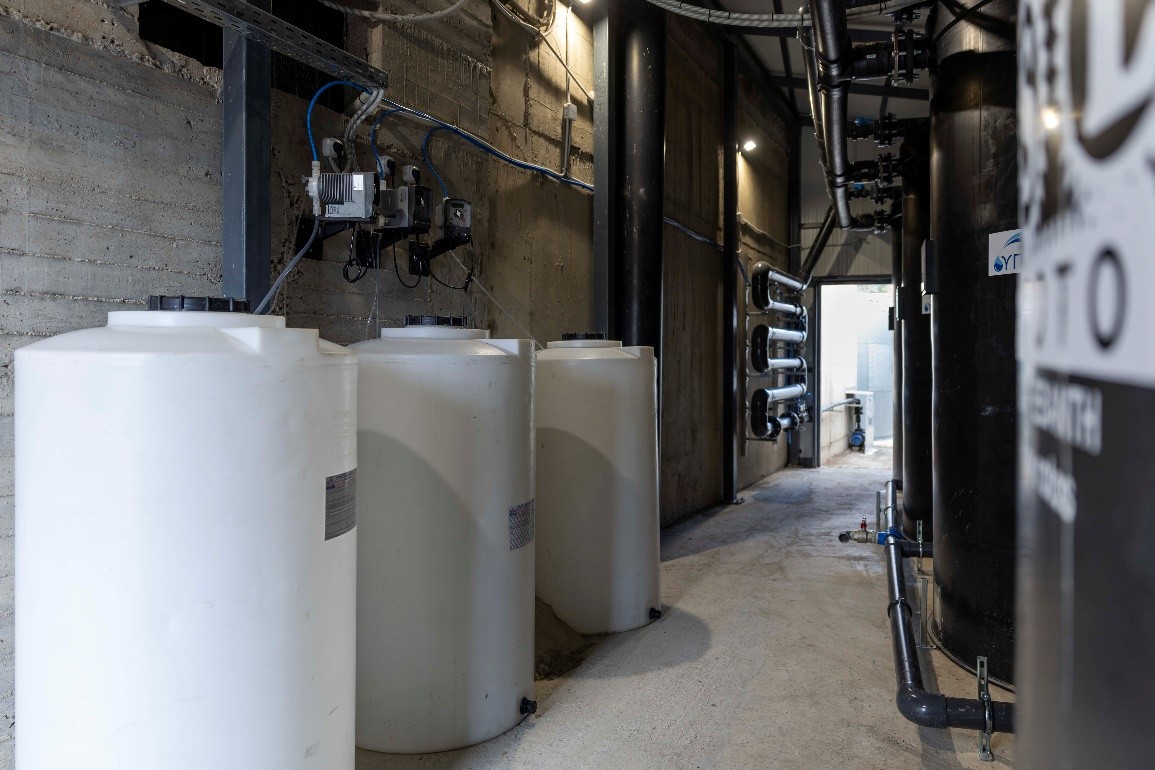
- Sand filters for the primary filtration of suspended solids.
- Carbon filters to remove organic compounds, improving water taste and odor.
- Pumps to convey water through the filtration systems
- Storage tanks for filtered, backwash, and intermediate flow stabilization.
- Pipe flocculation unit to aggregate fine particles into larger clumps using added chemicals.
- Chemical dosing systems for adding and mixing flocculants.
- Sedimentation tank to separate flocculated particles, reducing suspended solids and turbidity.
- Polishing sand filter to perform the final filtration step on the recovered backwash water.
- Recycling system piping treated backwash water back into the raw water tank.
- Distribution network to transport the final treated water to the municipality.
Implementation site
Tanagra
NCW type
- Brackish water (BrW)
NCW USE
- Other (Please specify below)
Self-Assessment
TRL : Technology Levels
TRL9
Description of the innovative component:
The innovative component is the retreatment of filter backwash water and its recirculation through the Water Treatment process at the WTP of Tanagra Municipality.
The recirculation / retreatment system which has been installed has the capacity to recirculate 100% the filter backwash water which is being produced. The finally treated backwash water is forwarded to the raw water tank and after the treatment process by the existing equipment of the Water Treatment Plant the clean water is distributed to the Municipality
Through this retreatment process the WTP increases its efficiency by 7 – 10 % and achieves near Zero-Liquid Discharge.
The recirculation / retreatment system which has been installed has the capacity to recirculate 100% the filter backwash water which is being produced. The finally treated backwash water is forwarded to the raw water tank and after the treatment process by the existing equipment of the Water Treatment Plant the clean water is distributed to the Municipality
Through this retreatment process the WTP increases its efficiency by 7 – 10 % and achieves near Zero-Liquid Discharge.
Obstacles to implementation
- Isuffi cient funding instruments to support solution for NCW
- High cost of technological solutions
- Lack of training of professionals to take up best practices in their portfolio
Obstacles to funding
The funding comes from the private sector. The difficulty was to establish the engagement and prove that such solutions can be effective.
How your Best Practice is economically feasible ?
Result of this assessment
NAEnviromental impact
SDGs
Energy consumption comment
NA
Validation/upscaling
The commissioning date of the technical solution at the WTP in Schimatari was in 17 of October 2025.
Potentiel of exploitation/outscaling
This Best Practice is a scaled-up intervention of a previous GWP-Med project (2023) which also took place in Tanagra Municipality in another WTP and will be replicated in the remaining two WTP of the…
Lessons learnt
This Best Practice constitutes a model case of successful investment in optimization of water assets, to prolong their lifespan, increase their capacity, and yield multiple benefits towards…
Highlighted KPI
Technical indicators
Average Treated flow rate
m3/Day
Suspended solids SS158400 g/Day
Economical indicators
Average total Cost
euro/m3 terated/day
Without consideration of the depreciation period
Average benefit of reuse
euro/Day
Land footprint
0.06
m2/m3/day


Social impact of the BP
Jobs created comment: NA